GitHub Actions Integration With Cloud Coding Agents
Actions gives coding agents the permissions, sandboxing, and review controls teams already trust.
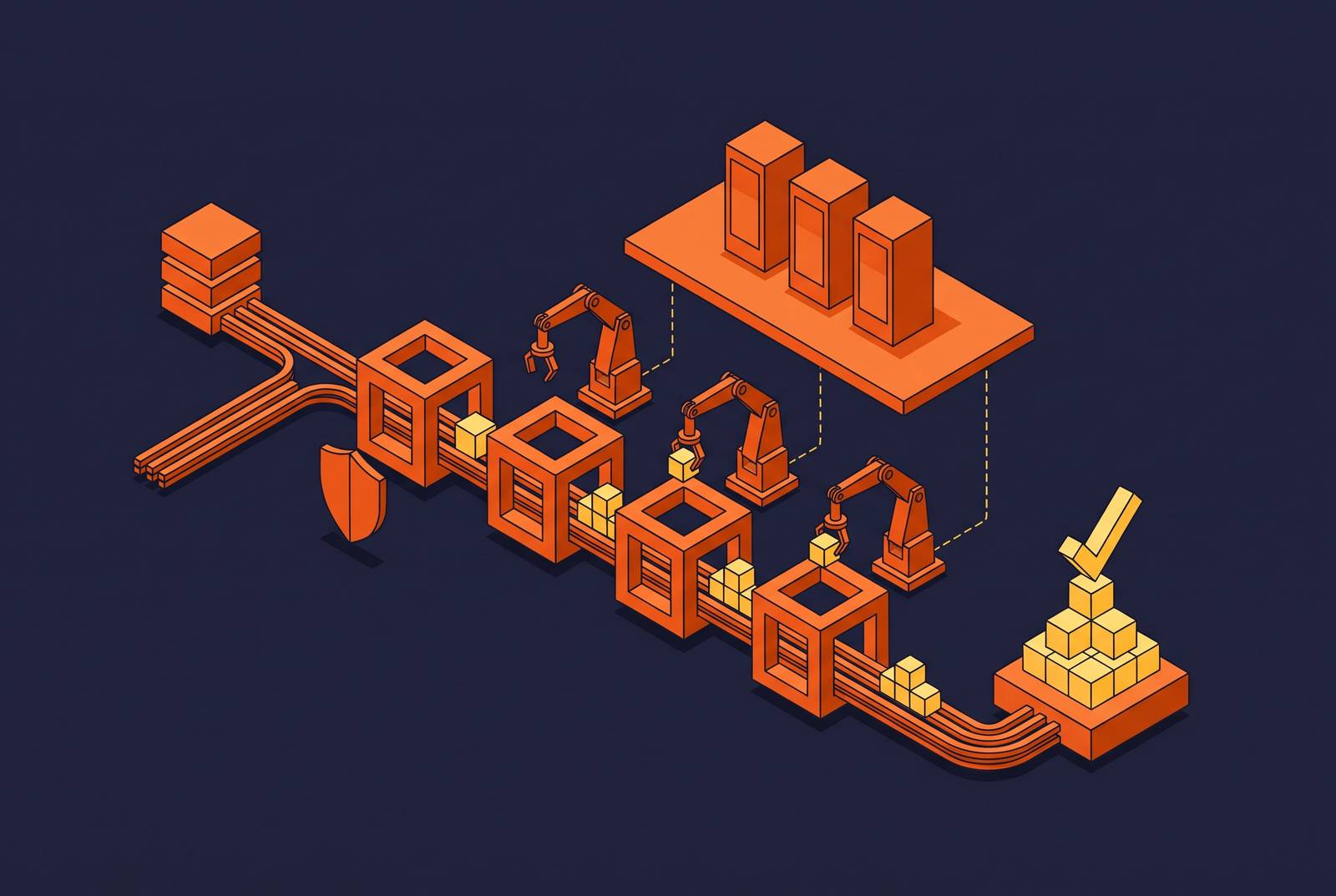
GitHub Actions works with cloud coding agents so they can take on bounded engineering tasks in the background and return the work for a human to review. Slack Code lets teams share conversations with an agent, while Linear issues can be assigned to GitHub Copilot’s cloud agent or Linear Agent. Actions is the natural execution layer because it already hosts repository automation, permissions, and review workflows. The decisive step is connecting those entry points to controlled execution and measurable output.
Why GitHub Actions became the default infrastructure for cloud coding agents
GitHub chose Actions when it started Project Padawan, the internal name for its coding agent. The choice followed the infrastructure already in place. Actions provided permissions, logging, auditing, sandboxed execution, and rich repository context where GitHub could put an agent to work. Those capabilities connect an assigned task to the code it concerns and the controls governing changes. Hosting the agent there avoided separating delegation from the systems teams already use to automate, test, and ship.
GitHub Agentic Workflows formalized that relationship in technical preview as of February 2026. Teams describe outcomes in plain Markdown, add the file to a repository, and compile it into a standard Actions workflow through the gh aw CLI. A coding agent then executes the work inside Actions. The resulting workflow remains part of repository automation. Plain-language instructions define the outcome, while Actions provides the execution infrastructure rather than leaving the agent as a separate interactive tool.
Visual Studio 2026 extended the same pattern to the IDE with a “Cloud” option in its Copilot Chat picker in April 2026. A developer assigns a task, GitHub creates an issue, and the work runs asynchronously on Actions infrastructure before returning as a pull request. The structural advantage of Actions integration is that engineers can use different entry points with the same execution model.
What asynchronous delegation actually means for how engineers work
Synchronous assistance needs an engineer to stay with the tool as it works. IDE plugins and chat sidebars offer suggestions while the developer directs the next step. Asynchronous agents instead receive a bounded task and work toward an output that the engineer will review later. The unit of work becomes a delegated task that returns as a pull request.
This model fits work that is bounded, testable, reviewable, and time-consuming. Adding tests, upgrading dependencies, fixing lint errors, performing mechanical refactors, synchronizing documentation, and handling small bugs all fit that description. Their scope gives the agent something concrete to complete. Their testability and reviewability give the engineer a basis for deciding whether the result is acceptable. A task without those properties is harder to hand off because it is unclear when the work is done.
For the engineer, the daily sequence becomes assignment, other work, and review of the returned pull request with its context attached. Review replaces implementation for that category of work. A human still has to accept the result, even though the agent can write the first implementation without someone watching it throughout. Consequently, the useful measure is whether the handoff produced work that a reviewer can assess and accept.
The categories of work GitHub Agentic Workflows can automate today
GitHub Agentic Workflows apply this delegation pattern to recurring repository work. Continuous documentation keeps READMEs and other documentation up to date as the code changes. Continuous code simplification repeatedly identifies improvements and opens pull requests for them, while continuous test improvement assesses coverage and adds high-value tests. Each gives an agent a clear kind of improvement to work on without an engineer having to make every change.
Continuous quality hygiene uses the same approach to look into CI failures and propose fixes for them. Continuous reporting creates regular accounts of repository health, activity, and trends. Not every useful output is changed code. Across these categories, the shared property is a reviewable artifact, such as an updated document, a labeled issue, or a pull request. Human oversight attaches to that artifact rather than requiring a person to direct the entire run.
The permission design supports this continuous operation. Workflows run read-only by default, and write operations require explicit approval through “safe outputs” mapped to pre-approved, reviewable GitHub operations, including creating a pull request or adding a comment. This differs from placing a coding agent CLI directly inside a standard YAML workflow, which tends to grant broader permissions than the task needs. Agentic Workflows constrain the permitted output as well as the execution. Recurrence therefore does not have to mean unrestricted repository access.
Choosing which agent engine runs inside your Actions workflow
GitHub Agentic Workflows support configurable engines including GitHub Copilot, Anthropic Claude, OpenAI Codex, and Google Gemini. Choosing the engine through configuration lets a team consider task fit separately from its decision to use Actions. It also prevents the workflow architecture from depending entirely on one model’s strengths. Harness-agnosticism, which platforms like Replicas, a cloud coding-agent platform that runs Claude Code, Codex, Cursor or OpenCode in isolated VMs and returns pull requests, also build around, is the practical operating principle.
Anthropic maintains anthropics/claude-code-action, an official GitHub Action that runs Claude Code inside Actions workflows. It provides a shell environment where access to tools including git, npm, and bash must be explicitly granted. Codex emphasizes autonomous, parallel execution in sandboxed environments, with a separate container for each task. Those differences give teams concrete selection criteria. Long-context reasoning tasks favor Claude Code, while batch parallel refactors favor Codex.
Cursor works mainly in the editor in VS Code and fits developers who want codebase indexing and real-time collaboration more than they want to hand off all the work to the background. OpenCode offers an open-source alternative with broad provider support, pay-only-for-tokens billing, and no vendor lock-in. These options address different working arrangements. OpenCode fits teams that want to choose their models without commercial subscriptions, while a workflow built around the editor fits an engineer who wants to take part throughout implementation. Routing by task preserves those distinctions instead of treating every coding request as equivalent.
What the sandboxed environment must provide for agents to do reliable work
An agent’s environment determines which tools, files, and network destinations it can reach while doing the work. Before giving an agent write access, a team must know how those boundaries work in practice. Model capability cannot compensate for an environment that exposes resources outside the task’s scope. Reliability depends on both useful access and enforceable limits.
GitHub Agentic Workflows execute agents in sandboxed containers behind the Agent Workflow Firewall. Proposed outputs pass through the safe outputs process before application. These controls serve distinct purposes. The container and firewall constrain execution, while output checks govern what leaves that execution environment as an applied change.
Filesystem isolation and network isolation must work together. A misconfigured environment can still expose secrets or permit data exfiltration when only one boundary is effective. For teams evaluating an integration, the practical questions concern repository scope, sensitive paths, permitted outbound domains, approval of tool calls, and rollback of a bad change. Those questions define what must be verified before production write access. A sandbox label alone does not answer them, and workflow configuration alone does not establish that network restrictions are enforced.
How can a team trigger coding agents directly from Slack, Linear, and GitHub?
Slack Code gives teams a type of channel built for work with agents, with GitHub as a launch partner. Agent sessions are shared and collaborative, so teammates can see how others prompt the agent and learn from those exchanges. The full conversation attaches as context to the resulting pull request. That makes the discussion part of the handoff. Work can begin where the team describes a problem rather than requiring a separate dashboard and a rewritten request.
GitHub Copilot users can assign Linear issues to Copilot’s cloud agent, a capability generally available since July 23, 2026. Separately, assigning work to Linear Agent lets its native coding agent write and test code in a secure cloud environment before opening a pull request. These are separate agent offerings within the ticket workflow. Linear’s Code Intelligence controls its agent’s access to the codebase so it can draw on repositories as shared product context as well as the issue description.
GitHub issues provide the most direct native trigger. When an issue is assigned to the coding agent, it explores the repository, changes the code, runs tests, and opens a pull request. Interactive @claude mentions on issues and pull requests also support delegation inside an existing discussion. Together, these entry points connect work coordination to execution without making the triggering interface the agent engine. Slack supplies shared conversation, Linear supplies assigned work, and GitHub supplies repository-native tasks and review. The conversation or ticket can initiate the work, while the pull request provides the place to evaluate its result.
What Ramp's internal adoption shows about moving from experiment to standard practice
Ramp’s internal agent Inspect demonstrates how cloud delegation can become standard practice through use. By the time of reporting, the majority of merged pull requests at Ramp were raised by Inspect sessions. Engineers independently found tasks where the agent matched human coding in quality, speed, or convenience. More than 150 people contributed to the project, and all sessions were public and open to collaboration.
That visibility gave the organization a shared view of agent work that individual local sessions cannot provide. Engineers could participate in an open system rather than treating delegation as a private interaction. Aggregate pull request volume rose significantly, but review time rose with it. The bottleneck shifted from implementation to review, so counting merged pull requests alone would have obscured the pressure created downstream.
The case makes attribution part of operating the workflow. Keeping a record of each run’s source, harness, model, and credential helps teams tell which tasks were worth handing off and which mainly added work for reviewers. DORA metrics need context from review pressure, AI-assisted pull request volume, code quality, rework, and incident patterns. Higher output does not establish that quality is holding. Teams still need to check code turnover and defect rates when it becomes easier to write an implementation than to get changes accepted.
The configuration decisions that determine whether agent workflows compound or stall
Teams should treat configuration as ongoing engineering work, beginning with authentication and cost control. Teams should choose the authentication backend deliberately. OIDC to Bedrock or Vertex eliminates static credential risk for enterprise deployments. Claude Code’s OAuth and API key options also require a clear decision before production use. Teams should plan how to use and pay for authentication before an unexpected bill makes them revisit the choice.
Teams should default to read-only access and authorize write operations through safe outputs. Agents should push only to branches they created, and requesters should not approve their own agent’s pull request. Network access needs enforcement beyond the workflow file. A trusted domain list should be validated at the firewall level, where the restriction must actually hold during execution.
Context configuration lets instructions survive beyond one conversation. Teams should maintain stable project rules, reusable domain knowledge, and explicit pull request review standards in CLAUDE.md or AGENTS.md. The context file makes engineering policy legible to the agent. It needs maintenance with the codebase as a configuration decision about shared standards that support consistent team behavior.
Teams should be able to choose a harness to fit each task. Teams should test each new agent configuration in a sandboxed environment equivalent to production before granting write access to main-line repositories. Measurement must begin before volume makes reconstruction impractical. Attribution should show which harness, model, and credential produced each pull request, and teams should track how much review work comes with the output. If review time grows faster than the merge rate, the workflow needs rebalancing. Asynchronous delegation becomes repeatable when the team can see both what it produced and what accepting that work required.