Why Local Coding Agents Break at Team Scale
They're designed for solo developers, not shared codebases or team coordination.
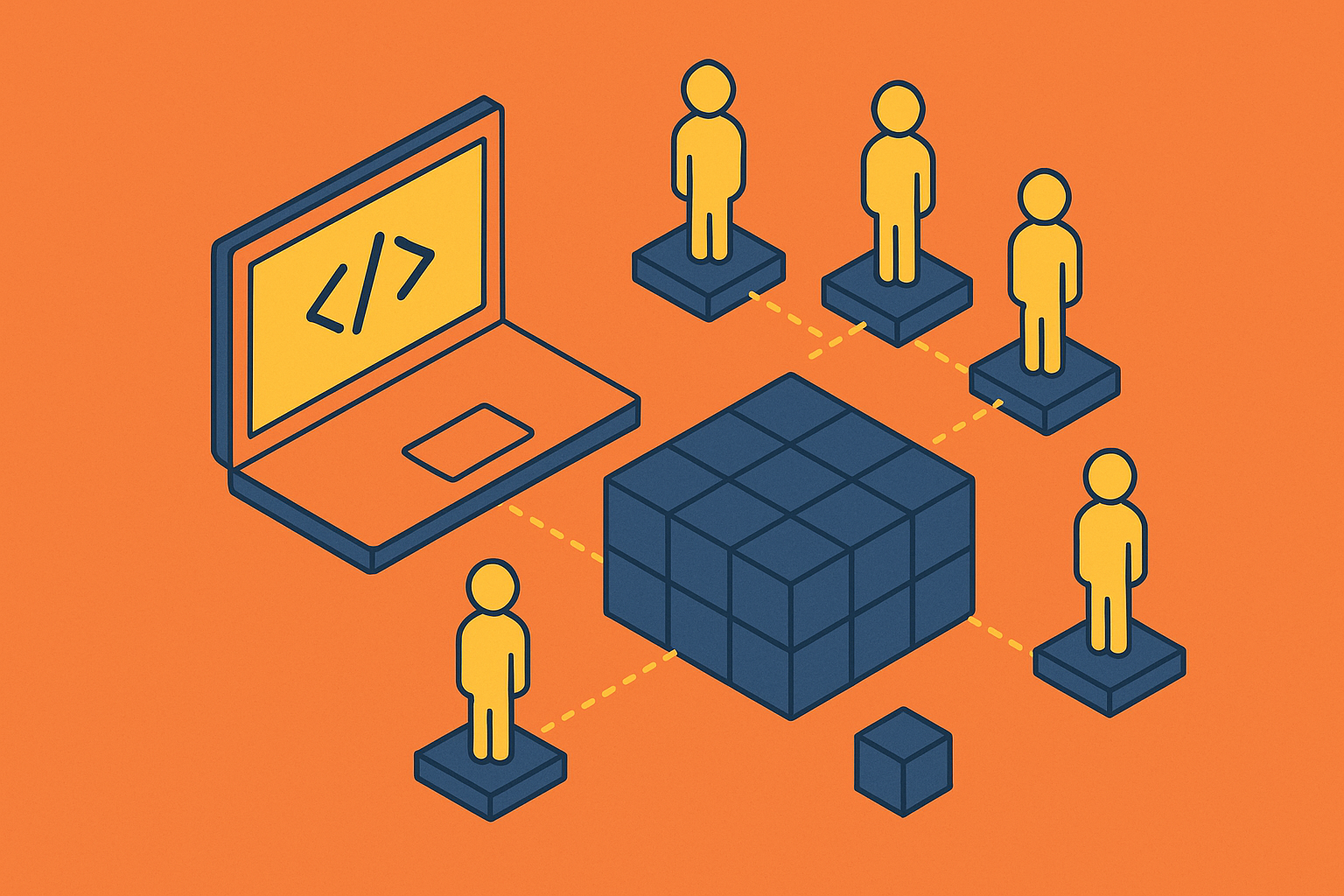
Local coding agents are built to serve one developer working alone on one machine, and that single design premise is what breaks the moment a team tries to run several of them at once. Every assumption baked into that architecture, how the environment behaves, who the agent is acting as, where its output gets reviewed, what record it leaves behind, holds up fine for an individual and fails in a predictable, structural way for a team.
Local coding agents, built around one developer on one machine
A local coding agent reads a filesystem, writes files, runs shell commands, and commits, all on the machine where the developer already sits. For one person, this works without friction. The environment belongs to them, the credentials belong to them, the terminal session belongs to them. The agent inherits all of it automatically: installed packages, shell history, environment variables, secrets sitting in a keychain or a .bashrc file, none of it configured on purpose, all of it simply there because the developer put it there over time.
That contract made sense when these tools suggested lines of code. That stops making sense once agents read issues, edit dozens of files across a codebase, run test suites, and open pull requests, all without a human watching each step. That's a different category of tool, with different ways to fail, and the local architecture that worked fine for autocomplete carries assumptions you only see once an agent acts on its own across a shared codebase. The unit this design was built for is one developer on one machine. What a team actually needs to support is dozens of engineers, a shared repository, concurrent branches, and whatever compliance regime the organization is already operating under. Those two units are not the same, and no amount of prompt engineering closes that gap.
Shared codebases and single-user environment assumptions
When you put more than one agent to work against a shared codebase, the environment each one inherits stops being a stable, private thing. It becomes a source of interference between agents that have no way of knowing what the others have already changed.
On a single machine, the agent's environment is just whatever the developer has installed, and it holds steady because one person controls all of it. Across a team, that control disappears. Engineers run different Node versions and different Python virtual environments, and their system libraries conflict in ways nobody has mapped out. An agent that runs correctly on one engineer's laptop can fail silently on someone else's because it quietly assumed the environment it happened to be tested in.
A local agent cannot install a package, start a service, or check its own work on its own. It acts directly on the developer's live machine. When it installs something, starts a process, or edits a config file, it does so on the host system, affecting every other process the developer happens to be running at the same time. For one person, that's a minor annoyance to clean up. Across a team, it is a reliability failure: the agent's output depends on local state nobody can reproduce, inspect, or trust after the fact.
Credentials and identity management under concurrent agent use
A local agent inherits its developer's credentials by design, which makes it convenient for one person and ungovernable for a team. Once multiple agents are running at once, no one can tell which action came from which agent, which human authorized it, or whether the access it used was ever appropriate.
Local agents typically pull secrets from environment variables, keychains, or config files scoped to one developer's machine and identity. Teams need shared access to API keys, deployment tokens, and database credentials that should never sit on an individual laptop. Without a dedicated secrets management layer, a team has two bad options: give every agent broad standing access, or scope credentials by hand for every single run. Neither holds up once the number of agents and the number of runs start to grow.
The credential risk is not hypothetical. A peer-reviewed study of 37,623 provenance-labeled pull requests from five commercial coding agents found hardcoded credentials in 0.9% of pooled agent PRs, compared with 2.2% of human PRs. Claude Code individually showed a higher rate, 3.3%, than the human baseline of 2.2%. Whatever the aggregate picture, the identity problem is the same for every agent running locally: there is no reliable way to separate what the agent did from what the human it's impersonating did.
That gap is clearest during offboarding. When an engineer leaves the company, every credential their local agent touched has to be found and revoked individually, because the agent never had an identity of its own to begin with, only borrowed access to someone else's. If every agent session doesn't map to a named human identity through proper SSO configuration, using SAML and SCIM against providers like Okta, Entra ID, or Google Workspace, a security or compliance review that asks who did what has no way to answer the question. If that mapping isn't in place before an agent reaches general use, access reviews and audit trails simply do not function.
Code review and merge quality when agents run in parallel
Local agents produce pull requests that land in a review queue built for the pace of human output. When you run several agents at once, review capacity becomes the limiting factor almost immediately, and the nature of agent-generated code makes that limit tighter, not looser.
Agent-authored pull requests have to clear the same gates as anything a human submits: owner review, coverage thresholds, linting, static analysis, secret detection. The trouble is that a local agent leaves no metadata connecting its PR back to the session, the tool, or the credential that produced it. Without a label like agent:claude-code paired with a session ID, a security team looking at a suspicious pull request has no way to trace it back to the run that created it. Every time a PR gate gets bypassed, you need to tie that bypass back to a named role and log it somewhere. A local agent produces none of that trail.
Running several agents in parallel compounds the review bottleneck: a backlog builds faster than reviewers can clear it, and the time teams spend working through that backlog eats directly into the productivity gain the agents were supposed to deliver. A study of Microsoft's early-2026 rollout of Claude Code and GitHub Copilot CLI, covering tens of thousands of engineers, found that adopters merged roughly 24% more pull requests than they would have otherwise. That lift only holds if review capacity keeps pace with what the agents produce, and for teams running agents locally, without session metadata or gate logging, it usually doesn't.
Proper review infrastructure closes that gap, so teams have something to actually look at while the work is happening. A draft pull request opens the moment a task starts, commits appear incrementally as the agent works, and a human has to approve it before any CI/CD workflow runs. GitHub's coding agent follows exactly this pattern: it works inside an ephemeral environment, pushes commits to a draft pull request as it goes, keeps session logs a reviewer can inspect, and waits for human approval before CI/CD kicks off. That inspection surface is precisely what fire-and-forget local execution never provides, and it's the reason branch protections still mean something when agents are involved.
What makes local agents produce no audit trail an engineering organization can actually use
Everything a local agent does, every file it touches, every shell command it runs, every API call, every package it installs, is visible only inside the terminal session where it happened. Close that session and the record is gone, leaving the organization with no durable evidence that any control actually operated the way it was supposed to.
That absence matters most under formal audit. A SOC 2 Type 2 review requires auditors to see evidence that controls operated consistently across the entire audit period, not just that they existed at some single point in time. A local agent session cannot produce that kind of evidence. There is no central log, no retention policy, no record an auditor can query to see what the agent did or why it did it. Every file access, shell command, pull request, and API call an agent makes needs to flow into the organization's SIEM for that evidence to exist at all, and local execution makes that structurally impossible, not just inconvenient.
This also explains why some agent rollouts scale and others get pulled after a quarter. A successful pilot and a durable production deployment don't differ on model quality. It comes down to whether identity, logging, code review, and incident response controls were built in from day one. Without full attribution, tracing every minute of agent runtime back to its source, its harness, its model, and its credential, there is no way to measure whether the agents are delivering real engineering value, and no way to satisfy the access reviews and offboarding checks that identity management alone can't resolve. Token spend on these tools can run into millions of dollars a year at large organizations, and without that attribution layer, there is no way to connect that spend to any measurable output.
Team coordination surfaces local agents cannot join
A local agent waits for a developer to open a terminal and type a prompt. It has no way to pick up a task from Slack, respond to an issue in Linear, or push a status update back to wherever the team actually tracks its work.
Modern engineering teams plan and coordinate through tools like these as a matter of course. Linear, for instance, treats agents as full workspace members: they can be assigned to issues, added to projects, and @mentioned directly in comments, the same as any engineer on the team. A local agent cannot take part in any of that. It cannot be @mentioned, it cannot stream progress to a Linear timeline, it cannot be triggered by a message in Slack, and it cannot return a finished pull request to the coordination surface where the rest of the team is actually watching for it.
It is a structural mismatch between a tool built for someone typing into a terminal and a team that plans and tracks its work across distributed, asynchronous systems. An agent invisible to those systems is, for coordination purposes, an agent that isn't really part of the team.
Harness lock-in and compounding failure as better models ship
Local agent deployments tend to settle into a single harness, a single tool, a single environment, a single integration path, and when a stronger model ships, swapping it in means rebuilding the execution environment, the credential mapping, and every workflow integration from the ground up.
In cloud agent infrastructure, the harness and the model are separate layers that can change independently. In a local deployment, they're fused together, so when you upgrade the model, you have to rebuild everything around it. Cloud agents such as Claude Code, Codex, and Jules all produce strong code on their own. What actually separates a deployment that scales from one that stalls is whether the identity, logging, code review, and incident response controls around the agent are already in place, not which model happens to be running underneath. A team that has built its execution infrastructure to be harness-agnostic can route a given task to whichever agent fits the job, Claude Code, Codex, or another, without touching the controls built around it.
That portability is the mechanism that lets a team avoid re-paying the same structural costs, environment setup, credential scoping, audit logging, integration wiring, every time the model landscape shifts under it. And the model landscape shifts often: the AI coding tool market moves in meaningful ways every quarter, and any team locked into a single local harness is perpetually a release behind. Every failure mode traced through this piece, environment drift, credential sprawl, unreviewable pull requests, a missing audit trail, invisibility to team coordination tools, has the same underlying fix: move execution off the individual machine and onto infrastructure that isolates each run, attributes it to a real identity, integrates with the tools the team already works in, and stays agnostic to whichever harness or model happens to be best this quarter. That is the structural answer the local model was never built to provide.