From Local Experiment to Cloud-Scale Agent Pipeline Without a DevOps Hire
Move agent work to isolated cloud runs, one layer at a time.
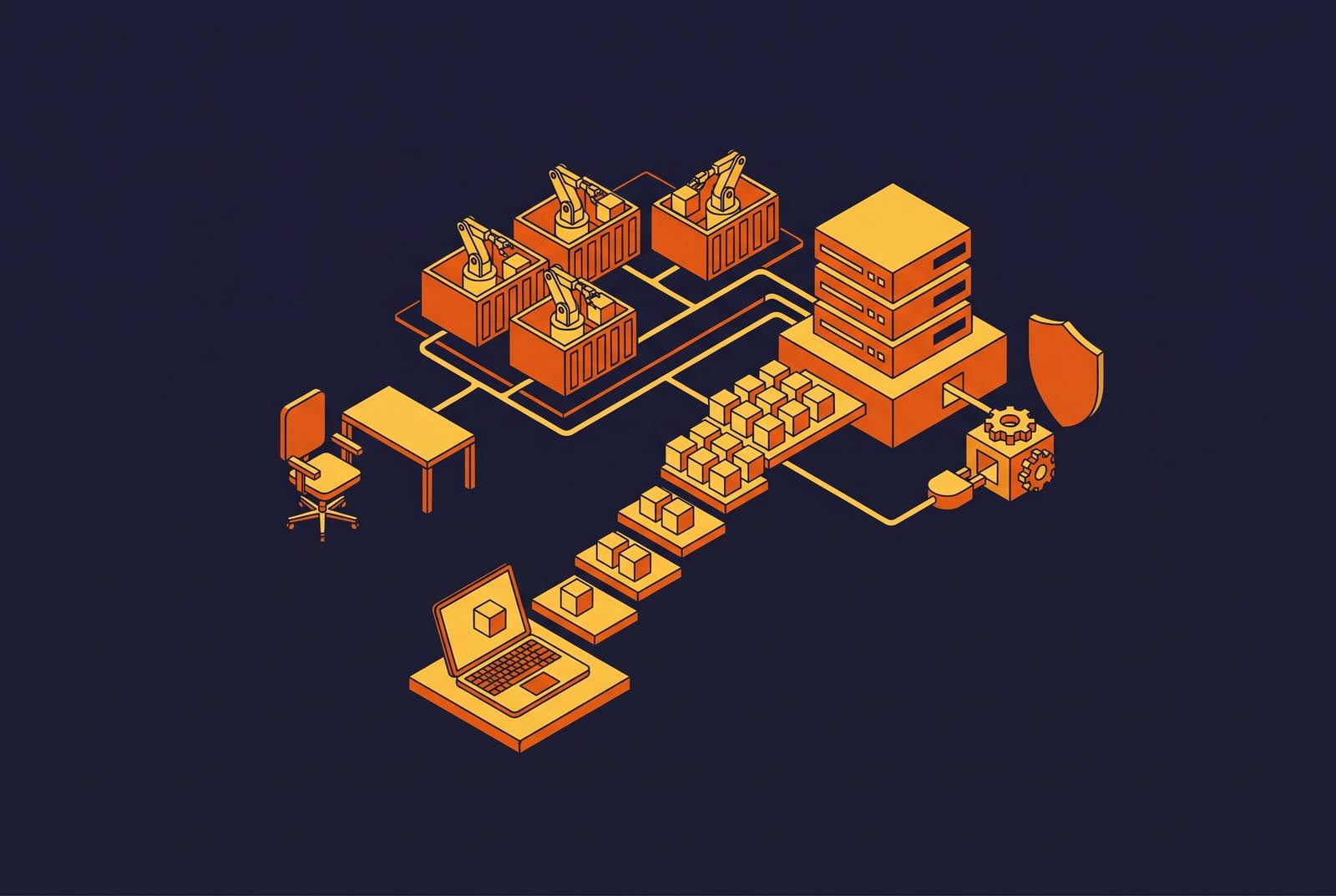
A bring-your-own API key cloud coding agent runner should let a team use its own Anthropic or OpenAI API key while delegating isolated execution, workflow integration, and pull-request delivery. Moving from local agents to that pipeline requires decisions in the right order. The named integrations below establish cloud execution paths, with support for customer-supplied keys remaining a separate buying criterion.
Why the local-to-cloud leap is harder than the original agent adoption
Scaling coding agents without a DevOps hire starts with closing the gap between individual use and team-wide execution. The JetBrains Developer Ecosystem Survey 2026 put daily agent use at 68% of professional developers worldwide. Adoption is no longer the central engineering question. An engineer can already delegate local work, yet a team still needs to decide where unattended tasks run, how they receive context, and how their output enters review.
Anthropic's 2026 Agentic Coding Trends Report describes a shift from assistance to collaboration, with agents handling implementation workflows that include tests, debugging, repository navigation, and pull requests. That changes the execution requirements. A local machine remains single-tenanted, unlogged, and disconnected from the issue trackers and review workflows needed for team-scale delegation. The work then shifts from choosing a model to setting an execution boundary, connecting workflows, and deciding how tasks are assigned. A hands-on engineer can make those decisions without taking on the management of shared infrastructure.
What "cloud agent pipeline" actually means, concretely
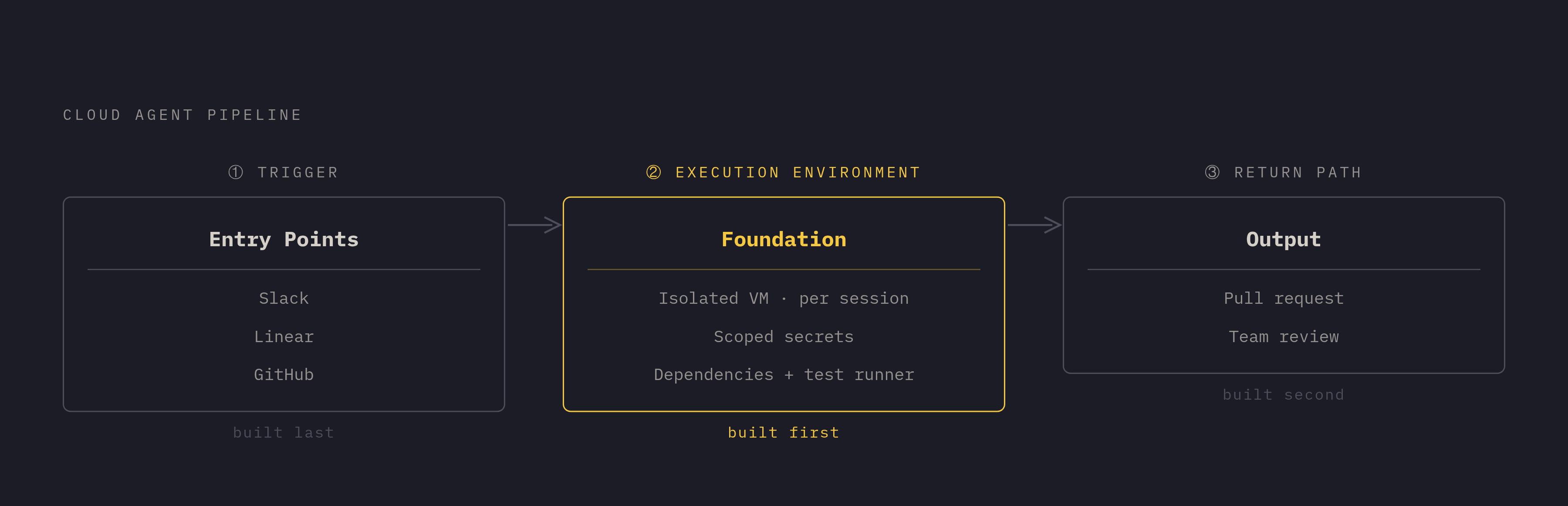
A cloud agent pipeline takes a task from Slack, Linear, or GitHub, runs an agent in its own isolated environment, and returns a pull request through the team's existing review process. No terminal or local machine needs to stay open. Its three layers are the trigger, where work originates, the execution environment, where the agent runs, and the return path, where output re-enters the team's workflow. Unlike a local session that an engineer watches and manually turns into a PR, this architecture supports delegation while that engineer does other work.
Those layers also establish the order of implementation. The environment comes first because every task depends on it. Integrations then connect the environment to work and review, while triggers determine which tasks enter it. Harness selection informs the environment's requirements, but it should not dictate an architecture that only one agent can use.
Choosing which agent to run in the pipeline, and why the answer should not be singular
Harness choice belongs at the task level. The JetBrains survey describes a pluralistic landscape in 2026, with Claude Code leading workplace adoption, Codex growing substantially since January 2026, and Cursor and OpenCode serving distinct workflows. Adoption alone does not establish task fit. A pipeline tied to one harness becomes harder to adapt when another agent better suits the work or a new model changes the available choices.
Claude Code is terminal-native and well suited to tasks that need complex multi-file reasoning, work over a long horizon, and a deep understanding of the repository. Cursor is IDE-native and good at real-time feature work and visual editing, while its Cloud Agents run in isolated VMs with parallel sub-agents. OpenCode is open-source and terminal-first, offering inspectable execution that composes with local toolchains and CI. The practical routing pattern is Cursor for in-editor work, Claude Code for refactors and debugging, and Codex for scheduled or background automation.
To support several harnesses, the execution layer has to meet their needs. Tooling, secrets, and network access need a boundary that works the same way with any model. The trigger and return path can then remain consistent regardless of which agent performs the task.
How do you run Claude Code or Codex in the cloud without managing infrastructure?
Per-session isolation is the foundation for managed cloud execution. An agent that installs packages, runs services, makes tool calls, and drives browsers needs an infrastructure boundary. When environments are shared, generated code can affect other sessions or expose secrets. A documented December 2025 incident in which a coding agent deleted a developer's files and keychain illustrates the stakes of an inadequate execution boundary.
Each run should get its own VM, pre-loaded with the team's dependencies and tooling, without ongoing access to production secrets. Network egress should be controlled as well. Codex's cloud documentation describes one such boundary: internet access is blocked by default during the agent phase, while setup scripts can use the internet to install dependencies.
For a team configuring the pipeline, the remaining requirements are session-scoped secret injection and access to the test runner. The agent needs to verify its output before returning a PR. Isolation also lets the team discard a failed session without affecting other runs, which cuts down on shared-state problems that would otherwise need attention. Customer-supplied API-key support remains distinct from these execution guarantees and should not be inferred from a platform's support for a particular harness.
Connecting the pipeline to where work already lives: Slack, Linear, and GitHub
With native integrations, teams can configure the trigger and return layers without building a custom pipeline. OpenAI launched Codex's native Slack integration with general availability in October 2025, followed by its Linear integration in December 2025. A PM can assign a Linear issue to Codex, which creates a cloud task, investigates the bug, proposes a fix, and posts a link to the completed task. No engineer needs to open a terminal. Repository authorization then connects that delegated work to the codebase and its review process.
Linear Coding Sessions launched on June 11, 2026, taking this workflow from the context in an issue through to writing the code. The agent reads the issue and discussion, investigates the repository, proposes an approach, writes code, and opens a pull request using harnesses including Claude Code or Codex. Linear uses the workflow internally to resolve around a third of incoming bug reports, mostly on the first pass. Its billing model uses a prepaid workspace-level pool of AI credits, with model tokens at the provider's published rates without markup and sandbox runtime charged for each 20-minute block. That credit model does not establish bring-your-own-key support.
Linear's Triage rules support “Delegate → Codex,” together with labels or properties, so incoming issues can be assigned automatically. Nothing merges without normal PR review in the Reviews tab. For a team implementing this path, the work is to connect the workspace, authorize repository access, and configure delegation rules.
The tasks that belong in the pipeline, and the tasks that do not
Reliable unattended tasks share three properties, which are bounded scope, a verifiable success condition, and low blast radius if the diff is wrong. Tests against an existing specification give the agent a result it can check, while a reproducible bug gives it a concrete failure to resolve. Mechanical refactors, dependency upgrades, lint fixes, and API migrations produce changes that a reviewer can audit line by line. Boilerplate, glue code, and documentation sync also fit when it is clear what the result should look like.
Security-sensitive authentication, payment, and secret-handling changes require closer human control, as do large ambiguous changes without machine-verifiable success conditions. Tasks touching production infrastructure or standing credentials directly do not belong in this pipeline.
The report identifies “tasks that are easily verifiable” as effective agent work because a tight feedback loop lets the agent test its own progress. Internal tools, work to expand test coverage, and refactors are therefore good places to start. Repository preparation strengthens that loop. Clear conventions, a short architecture document, and test patterns that are written down give the agent a clearer context to work in without changing the model. They also make its proposed change easier for a reviewer to judge.
The review bottleneck that fast pipelines create, and how to solve it without slowing down
A fast generator can produce a slow delivery system. When PR creation outruns human review, the backlog grows, cycle time extends, and change failure rate can rise even as deployment activity increases. More generated code is not the same as more completed work. The report identifies scalable human oversight as a condition for maintaining quality while moving faster. Review capacity therefore belongs in the pipeline design.
The first adjustment is one focused change per task. Smaller PRs reduce the work required to understand intent, inspect the diff, and assess the test evidence. Agents can also summarize what changed and why, flag uncertainty, and annotate the diff with test results. The task-scoping discipline that makes execution reliable also reduces the cost of reviewing its output.
Generation cadence should then match the team's review capacity. Linear's triage automation can be configured to delegate at that cadence. PR analytics can reveal which task categories spend longest in review and need a different review path. The team should track median PR cycle time for agent-generated work separately from that for human-generated work. A rising value is an early signal that output is arriving faster than the team can consume it.
What to measure once the pipeline is running
Activity metrics lose much of their value when agents can generate activity in seconds. Lines of code, commit counts, and story points can go up without the team shipping useful work. Suggestion acceptance rate is also insufficient on its own because accepting a correct suggestion and accepting an incorrect one look identical. DORA identifies token consumption as a gameable vanity metric when treated as performance, encouraging productivity theater, wasted spend, and technical debt. Token use is not evidence of engineering leverage.
Delivery and quality need to be read together. Lead time from issue assignment to merged PR and deployment frequency show whether work moves through the system faster. Change failure rate and code churn show whether that speed creates rework. Leverage measures output per unit of real engineer effort, including what agents shipped, and directly tests the claim that the pipeline increases delivery without adding headcount.
Improvement also requires attribution at the level of each PR. The source, harness, model, and task type identify which combinations perform well. Without those distinctions, a team cannot reliably route future tasks based on prior outcomes. The practical recommendation is to instrument attribution during setup. Retrofitting it after a quality problem leaves the team without the context needed to diagnose earlier runs.
The sequenced path, end to end
Implementation begins with the execution contract. Per-session VMs, prepared dependencies, scoped secrets, controlled egress, and test access define what any chosen harness must be able to use. Harnesses can then be matched to task types within that boundary. Native integrations or the platform's API connect those runs to Linear, Slack, or GitHub, while routing rules determine which categories enter automatically. Tasks with a clear scope and repository conventions that are written down make that delegation precise enough for the agent to work unattended.
Before widening delegation, review design and attribution need to be in place. Focused PRs, agent annotations, and capacity-aware triage connect generation speed to the team's ability to merge useful changes. Delivery, quality, leverage, and per-PR attribution then provide the evidence for expanding or adjusting the pipeline. No new approval system is required. The engineer's role becomes orchestration of implementation work, with architecture and strategy remaining human responsibilities rather than shared infrastructure becoming a new full-time job.