Cloud vs Local Agent Environments for Engineering Teams
Local machines cannot scale agents across teams without sacrificing security and speed.
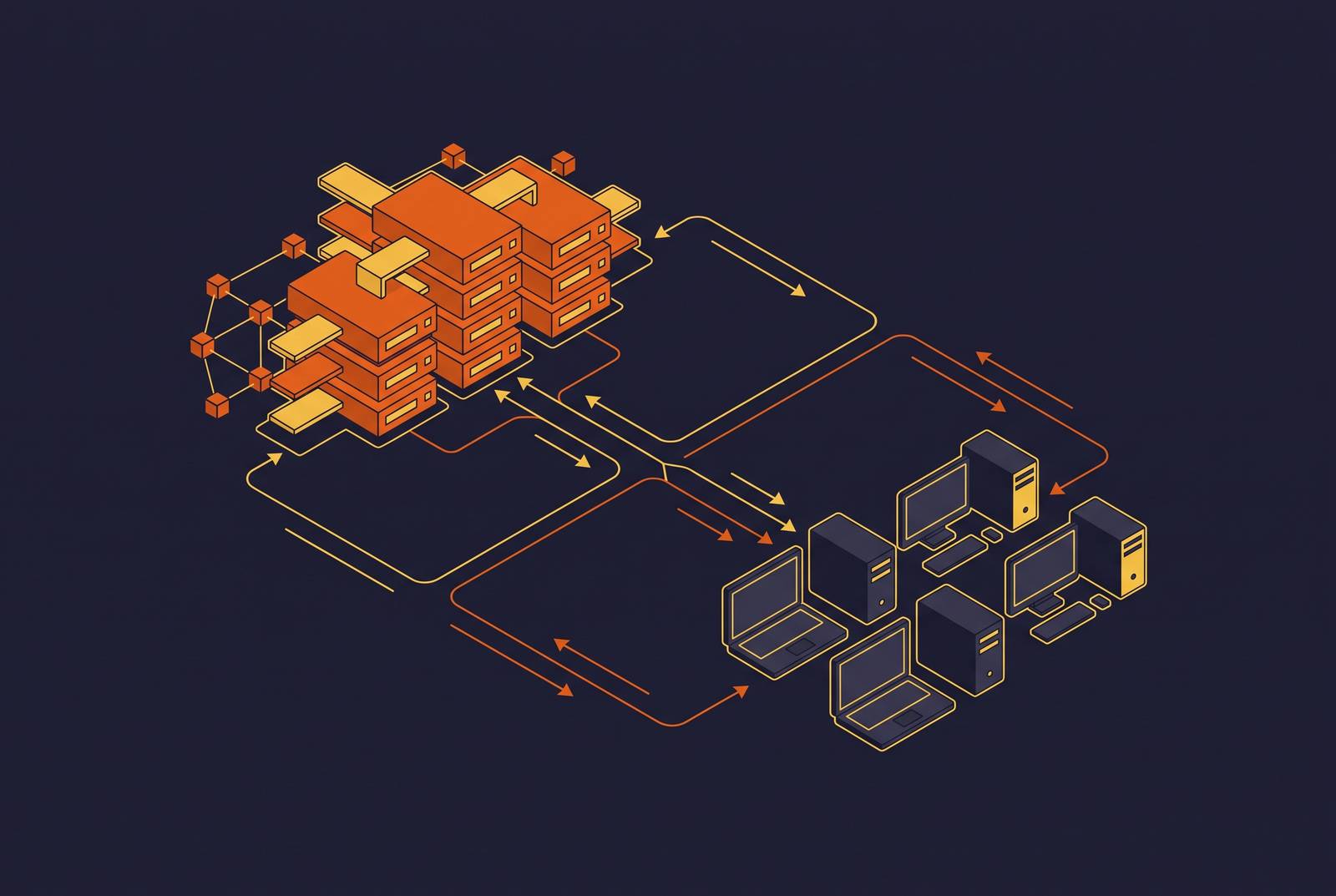
The first agent on a laptop is fine. It runs in one developer's context, with that developer's permissions, that developer's installed tools, and no other process competing for attention. The trouble isn't a tooling choice gone wrong. It comes from three structural constraints, isolation, parallelism, and reproducibility, that a single machine cannot satisfy at the same time once more than one agent or more than one engineer enters the picture. Scale, in this setting, means two separate things: more engineers doing the same kind of work, and more tasks running at once for each engineer. Both run into the same wall.
The three constraints feed each other. An agent sharing a machine with a developer's SSH keys and cloud credentials is an isolation problem. An engineer who wants three agents running while doing something else is a parallelism problem. A second engineer who needs to start from the same place as the first is a reproducibility problem. One comparison of cloud development environments for coding agents names these three, isolation, parallelism, reproducibility, as the structural problems local execution cannot solve, and adds a fourth: attribution, the record of what ran that local execution never keeps. No single fix on a laptop addresses all three. That's the shape of the problem the rest of this piece works through, one constraint at a time.
Isolation and the risks of sharing a developer's machine
An agent that runs generated code on a developer's laptop inherits that developer's credentials, file system access, and installed tools. No engineering team would hand a junior engineer that much reach to run code nobody has reviewed, yet that is the default setup for a local coding agent. The risk here is concrete: an agent with access to SSH keys, cloud credentials, and the rest of a developer's environment can install packages, write files anywhere the developer can, and make outbound network calls, all inside the same permission boundary the developer operates in. If the agent misreads a task or runs a bad command, nothing stops it at the credential layer, because there is no separate credential layer.
Isolation also breaks between agents, not just between agent and developer. Two agents running on the same machine share its state: the packages installed, the services running, the file locks held. One agent's work can quietly corrupt or interfere with another's, and neither agent has any way to know it happened. The standard workaround is Git worktrees paired with careful management of separate shell sessions, so each agent gets its own branch and its own terminal. That workaround buys back some isolation, but it costs setup time and ongoing coordination for every task, and that overhead eats directly into the time delegation was supposed to save. The failure here is a property of running untrusted, autonomous code on the same machine that holds a person's keys.
Parallelism as the productivity argument local environments cannot deliver
The economic case for coding agents is delegation: hand off several tasks at once, step away, and come back to pull requests. That argument depends on running more than one agent at a time, and a single laptop supports maybe one or two before resource contention erases the benefit. When you run several agents locally, they compete for RAM, CPU, and disk I/O all at once. A single AI coding session already uses a meaningful share of a laptop's memory on its own, so every additional agent on that machine multiplies the cost directly.
The irony compounds the problem. The developer is supposed to be free to do other work, design, review, planning, while agents run in the background. Instead, the machine slows down at the exact moment it's meant to disappear into the background. A pull request that shows up while an engineer is in a design meeting is the entire point of delegating work to an agent in the first place; a laptop fan spinning at full speed because three agents are fighting for the same eight gigabytes of memory is the opposite of that. At the team level the math gets worse, not better: if each engineer wants several agents running at once, the number of isolated, concurrent environments the team actually needs quickly outgrows what any one machine, or any fleet of individual machines, can reasonably provide. Git worktrees help with the isolation half of this problem, but they do nothing for the resource contention, and they break down entirely once a task needs to start a database, run a service, or drive a browser, work that needs a full, configured environment.
Reproducibility across engineers: why "works on my machine" is worse for agents than it ever was for code
When an agent task starts on an engineer's laptop, it inherits that laptop's dependency versions, installed tools, stored secrets, and runtime configuration. Two engineers given the same prompt get two different execution environments, and two different sets of ways the task can fail. This is a familiar problem in software development, and containers and dev containers have gone a long way toward solving it for human engineers who write and test code by hand. Agents strain that solution further, because an agent doesn't just build and test code the way a human does. It installs packages mid-task, starts services, and checks its own work by running it, so the environment is no longer a build artifact. It's the agent's actual operating context, and any drift in that context changes what the agent can do and how it behaves.
The practical cost appears in debugging. When a task succeeds on one engineer's machine and fails on another's, the first question is whether the environment did something wrong. Sorting out agent behavior from environment drift takes longer than debugging a normal code failure, because the agent's actions and its surroundings are tangled together in a way a compiled binary's aren't. Onboarding makes the same problem visible from a different angle: a new engineer setting up a laptop to run agents faces the identical dependency-alignment and version-matching work that local development has always demanded, which erases much of the productivity gain agents are supposed to deliver for anyone not yet fully configured. One comparison of cloud environments frames the fix this way: every task should start from the same dependencies, tools, and secrets, defined once rather than configured separately on each machine, something that is structurally out of reach when execution lives on individual laptops. A cloud environment removes the setup step for a new engineer entirely, because that engineer can open a browser link and land in the same environment everyone else already works in.
The fourth failure: local runs leave no record of what ran, what it cost, or what shipped
Even a local agent run that succeeds leaves nothing behind. No log records which tasks ran, which agent handled each one, how long they took, what they cost in inference, or whether the resulting code ever made it to production. That absence matters more at the management layer than at the individual engineer's desk. Without attribution, a team can't measure what its agent investment is actually returning, can't audit what an agent touched or changed, and can't tell whether that investment is producing more shipped code or just more open pull requests waiting on review.
The gap also raises problems in task routing. Teams that route tasks to whichever agent performs best on a given class of work need outcome data to make that call, and without a record of what ran and what it produced, there's no outcome data to route on. Attribution is the organizational consequence of the first three failures: once execution is scattered across individual laptops with no shared record, the record simply doesn't exist to begin with.
What a cloud agent environment must solve
A cloud agent environment that actually fixes the local failure modes has to do four things: run each task in its own isolated environment with its own credentials and tools, support many tasks running at once without being limited by any one developer's hardware, start every task from a configuration that's reproducible by design, and keep a record of what ran and what it produced. Those four requirements map directly onto the four failures just described, and they give a concrete checklist for evaluating any platform in this category.
Isolation in a cloud setting means sandboxing at the level of the individual task: each run gets its own VM or container, loaded in advance with the team's dependencies and the agent's credentials, with no state shared between runs and no proximity to a developer's personal credentials. Inside that sandbox, an agent can install packages, start services, and drive a browser to verify its own work, and it never touches any other run or any developer's machine. Parallelism, under this architecture, becomes a question of how many tasks the infrastructure is provisioned to run, which scales with the team's needs. Reproducibility comes from defining the environment, dependencies, secrets, tooling, once and provisioning it identically for every run, whether that run was triggered by an engineer in Slack, a ticket in Linear, or an automated pipeline. Attribution follows from simply recording every run: which task, which agent, which model, how long it took, what it cost, and what came out of it, down to the credential level.
The market serving this need splits into a few distinct tiers: infrastructure built for teams constructing their own agent products, agent workspaces that bundle the environment, the agent, and the trigger together into one product, and hosted versions of specific agent tools. One comparison of cloud dev environments separates these tiers explicitly and lays out what a team takes on by choosing each. The choice is about deciding which layer of that stack the team wants to own and which it wants handled for it.
Why harness choice belongs in the infrastructure conversation
If a cloud environment locks a team into one agent harness, it recreates vendor lock-in at a higher level. The environment becomes reproducible and scales the way it should, but the team loses the ability to route a task to whichever agent handles it best, and that loss matters because model performance doesn't sit still. Independent coding benchmarks have shifted the top score between providers more than once within the past year, making committing to a single vendor's harness a bet on that vendor's future model roadmap and a judgment about present capability only for the moment it's made.
Cursor, Codex, and Claude Code's own hosted cloud offerings are legitimate choices for a team that has already settled into one ecosystem and has no near-term reason to move off it. The case against single-harness lock-in is a case for treating agent selection as something a team can change without having to rebuild its infrastructure around a new vendor. A cloud environment that provisions any agent into the same isolated, pre-configured VM, instead of binding the workspace to one harness, turns agent choice into a routing decision the team can revisit as models improve, rather than an infrastructure commitment it has to live with. Replicas works this way: it runs Claude Code, Codex, Cursor, or Opencode inside the same sandboxed VM infrastructure, triggered from Linear, Slack, GitHub, or GitLab, so switching which agent handles a task doesn't require touching how the environment or the workflow is set up. A guide to cloud coding agents built around this category frames that combination, task delegation, agent choice, and verification inside a running environment, as the strongest reason to put a platform like this on a shortlist.
Where local still wins
None of this makes local execution wrong everywhere. It remains the right choice for a specific, bounded set of situations: air-gapped or regulated environments where source code cannot leave the network perimeter, systems or kernel-level work that needs direct hardware access, and single-developer projects where collaboration across a team isn't the point. For industries where source code counts as regulated data, there's no path to a cloud agent environment until a vendor can meet the applicable data residency requirements, and for those teams, local or self-hosted execution is the only option that actually works today, not a fallback.
OpenCode's support for local and self-hosted models through Ollama and vLLM matters directly here: a team that needs agent capability without sending code to the cloud at all has, in a locally hosted model paired with a locally running harness, the best answer currently available for that constraint. A simpler boundary helps separate the rest of the cases: if a task is well-defined enough to hand to a junior engineer without real-time supervision, it fits cloud agent execution. But if the work needs ongoing architectural discussion or tight collaboration while it happens, local, interactive tooling still serves it better. Cloud agents are strongest at execution once a task is scoped. Design work with a tight feedback loop between developer and tool still benefits from running on the developer's own machine. The structural failures described earlier in this piece are real constraints on local execution at team scale, and these exceptions don't undo that, they mark where the constraints genuinely don't apply.
How to evaluate a cloud agent environment before committing
Testing a cloud agent environment should follow the same order the failures appeared in: isolation first, then parallelism, then reproducibility, then attribution, using the team's own repository and its own real tasks. Start by assigning a scoped task and confirming that the agent runs in its own VM with its own credentials, that it can install packages and start services inside that VM, and that it has no path to developer credentials or to another agent's state. One guide to evaluating cloud coding agents recommends giving each finalist platform the same task from the same repository snapshot and examining the environment the task ran in, not just the result it produced.
Next, push parallelism under real load: run several tasks at once and confirm the platform scales without one task slowing another down, and that each task starts clean regardless of what else is running. Test reproducibility by having two engineers trigger the identical task from the identical repository snapshot and comparing the environments each one got, dependencies, tools, secrets, not just whether the output matched. Before signing anything, confirm that every run gets recorded with its agent, model, credential, duration, and cost, and that this data can be exported at a level of detail useful for actual engineering analytics, not just a summary dashboard. A comparison of nine platforms in this category notes that startup times, deployment options, and pricing change often enough that documentation can go stale between when it's written and when a team reads it, so repository access, secrets management, network access, and which features sit behind which pricing tier are worth confirming directly with each vendor before a trial begins. Teams that keep their own record during this process, task success rates, how long engineers spend reviewing output, which tasks failed and why, end up with evidence of how the platform performs on their actual work, which is a sturdier basis for a decision than how any platform performs on a demo.